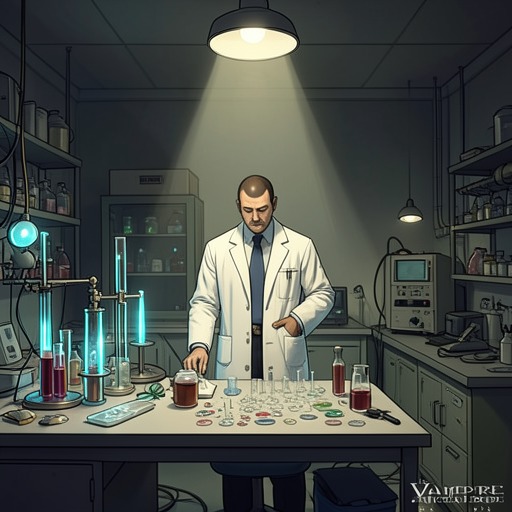
Cross-species pregnancy
The Vampire Prince’s BrideCross-species pregnancy is a rare reproductive condition in which parents from different species conceive a child despite biological differences that ordinarily make breeding impossible or dangerously unstable. In the narrative, the state is defined most fully by Lisa’s pregnancy with Zon’s T’Shav child: what begins as an unexpected consequence of intimacy becomes a test of universal DNA, a medical emergency, and a source of institutional interest in the child’s possible value to an entire species.
Definition and Biological Conditions
Cross-species pregnancy depends on the existence of shared genetic structures across species. When Lisa asks whether all species share DNA and whether interbreeding is possible, Zon explains that the average pregnancy lasts seventy-two standard weeks. He identifies Lisa as eight standard weeks pregnant, establishing that the pregnancy is not merely theoretical but already developing. A later genetic scan confirms T’Shav DNA in the fetus, while Lisa recognizes that her universal DNA has made conception possible. The condition therefore rests on a biological bridge between species rather than on ordinary human reproduction.
Zon believes conception probably occurred during the couple’s first night together. He connects the event to T’Shav reproductive physiology, explaining that male musth excites the female heat, while also emphasizing that T’Shav are notoriously difficult breeders. The pregnancy is presented as unprecedented within his species: Zon states that no mixed child with one T’Shav parent has ever existed. Lisa’s universal DNA consequently changes the meaning of her body, making her not only human but also a possible reproductive link between otherwise separated populations.
Medical Risk and Uncertain Viability
The discovery carries immediate danger because cross-species breeding has historically produced catastrophic outcomes. Zon warns that such pregnancies generally do not work out: babies may be born with severe disfigurements and be unable to survive even when carried to term. More commonly, the mother’s body rejects the fetus, placing both mother and child at risk. The survival rate for both is described as extremely low, so the pregnancy is framed less as a routine gestation than as a precarious biological exception.
The medical examination intensifies that uncertainty. Lisa struggles to remain still while a doctor presses scanning nodules against her exposed abdomen, generating a three-dimensional holographic image of her internal body. The technology gives the medical team an unprecedented view of the pregnancy, but it does not provide a decisive prediction. When Zon asks how likely the fetus is to reach term, the doctor explains that the answer may remain unknown until the fetus is fully formed. By then, ending the pregnancy would carry severe risks. Scientific visibility therefore does not equal control: the scan can identify the hybrid condition, while the crucial question of survival remains unresolved.
Bodily Autonomy and Institutional Power
Lisa’s pregnancy places her body at the intersection of desire, danger, and authority. Before the pregnancy is confirmed, she experiences attraction to Zon while reminding herself that he is an alien and that she should not want him. That conflict gives the pregnancy a relational origin, but the consequences quickly exceed the private relationship. The child becomes an object of medical interpretation and, later, a possible resource claimed by institutional science.
This political pressure is explicit when Niqæsh confronts Shay over a disease devastating the Stlozyn population. She says that the child Lisa carries should not be possible and identifies it as the key to curing her people. The pregnancy is thus recast from a personal and medical condition into a public instrument. Its value is assigned according to what the fetus might reveal or produce for others, while the risks remain concentrated in the pregnant body. The surrounding conflict exposes a recurring ethical imbalance: the institution seeks knowledge and a cure, but the mother and child bear the physical consequences of experimentation or intervention.
The same logic appears in Brask’s discussion of pregnancy as proof. He tells Libba that the board would require evidence and that she would have to be pregnant with his child. In that context, pregnancy functions as legal or political evidence rather than solely as a bodily state. Brask’s jealousy and discomfort when imagining Libba carrying Biryl’s child reveal the emotional cost of treating reproduction as a procedural solution. Across these episodes, pregnancy can be intimacy, proof, leverage, or public property, depending on who controls its interpretation.
Cross-Species Kinship and Hybrid Identity
The state unsettles the boundary between human and nonhuman identity. Shay explains that the Stlozyn ancestors were human people taken from Earth centuries earlier. Their later divergence involved both the intensification of certain genes and the addition of DNA strands that enabled shape-shifting. This history means that species difference is not presented as an absolute biological divide. It is the product of migration, modification, inherited traits, and long-term transformation.
Lisa’s pregnancy makes that history physically present. Her human universal DNA can align with Zon’s T’Shav genetic material, allowing a child to exist where T’Shav biology had previously recognized no viable precedent. The fetus is therefore both a threatened life and evidence that species boundaries are porous. Its hybrid status challenges the assumption that human and alien bodies belong to separate reproductive categories, while also making the child vulnerable to being defined by the needs of the communities that surround it.
The condition also links reproduction to technology. Lisa’s bionics adjust rapidly when she wakes, and later medical equipment maps her abdomen through a holographic scan. Elsewhere, bodies are altered through artificial procedures and devices, but cross-species pregnancy differs because its central transformation occurs through living genetic compatibility. The narrative repeatedly places organic bodies beside engineered systems, suggesting that identity is produced through relations among biology, technology, and social classification rather than through a pure human essence.
Narrative Significance and Consequences
Cross-species pregnancy is significant because it converts an intimate encounter into a challenge to the biological and political order. Lisa and Zon’s relationship creates the first known mixed T’Shav pregnancy, but the discovery immediately raises questions about survival, medical intervention, scientific ownership, and the status of the child. The fetus is simultaneously a possible family member, a medical risk, and a proposed cure for a population-wide disease.
The condition also gives the narrative a powerful contrast between possibility and danger. Universal DNA makes conception possible, yet compatibility does not guarantee safety. The pregnancy opens a new future while carrying the threat of fetal rejection, deformity, maternal death, or coercive experimentation. That tension prevents hybridization from becoming a simple symbol of harmony: crossing species can create kinship, but it can also expose the pregnant person to intensified surveillance and institutional control.
In this sense, cross-species pregnancy functions as a biological threshold. It joins human and alien ancestry, private desire and public crisis, and technological medicine with vulnerable flesh. Its decisive revelation is that the species divide is neither fully natural nor securely maintained; it can be crossed by a body, but the social consequences of that crossing must still be fought over by lovers, doctors, scientists, and governing institutions.